Metrobus March – M91

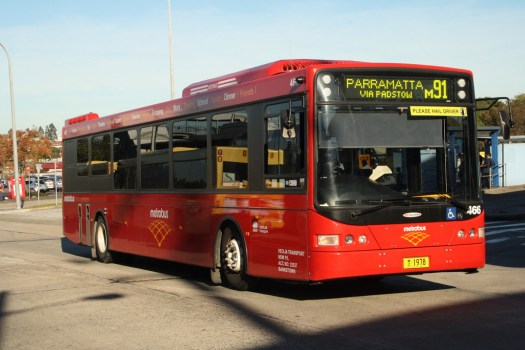
Route M91 operates between Parramatta and Hurstville via Granville, Chester Hill, Bankstown and Padstow. It commenced operation on 7 February 2011.5975819881_63a3c41154_b.jpgBus services began along the current Route M91 corridor in June 1948 when Route 88 between Bankstown and Padstow commanded. In 1964 Route 88 was extended to Hurstville. In October 1992, Route 88 was renumber 948. Route 320 operated between Parramatta and Bankstown via Chester Hill, beginning operation in February 1980. It was renumbered 910 in July 1987. Route M91 replaced Routes 910 and 948 in February 2011, taking strain off the heavily congested Bankstown Interchange.
In the 2013 “Sydney’s Bus Future” report, the M91 was designated as a rapid route, with priority to be given in terms of bus priority infrastructure and timetable upgrades.

The M91 runs every 10 minutes during peak periods, 15 minutes during off-peak weekday periods, and 20 minutes on weekends. It operates between 6am and 8pm daily. It is operated by Transdev using 12.5m buses out of their Bankstown, Kingsgrove, Menai and South Granville depots.

Farewell Region 6 – Kingsgrove Depot

Kingsgrove Bus Depot is one of the four bus depots in State Transit Region 6 that will be handed over to Transit Systems this July.

Image result for kingsgrove depot
Notice of the opening of Kingsgrove Depot

Kingsgrove depot opened on 22 February 1948 to take the pressure off the crowded Burwood depot. It initially began operating 12 routes with a fleet of around 50 buses. In most cases, these routes were located much closer to Kingsgrove then Burwood, allowing for reduced dead running and higher efficiency.

Image result for kingsgrove depot
Buses laying up at Kingsgrove depot

Since then it has grown to be home to 166 buses servicing dozens of inner west routes. It is one of two home depots for the Bondi to Burwood Metroline 400 routes and houses 15 dedicated high capacity buses just for this route.


Qantas Perth-London Inaugural Flight

*Not exactly NSW transport, but still very noteworthy*

Today Qantas operated the inaugral QF9 flight between Perth and London Heathrow. This was the first ever non-stop commercial flight between Australia and Europe. The flight was operated by VH-ZND “Emily Kame Kngwarreye,” a Boeing 787-9 aircraft with 236 seats.

DYfMdx6VwAASgVOImage result for emily kame kngwarreye qantas 787

The new groundbreaking flights allow for a 17 hour journey time between Australian and the UK. The original Qantas flights from Australia the UK in 1947 back in 1947 took 55 hours over 4 days. The new flight is 7828nm long, making it the longest 787 flight and second longest flight overall in the world.

The flight run to the following schedule;

QF9 MEL1620-1720PER1850-510+1 LHR D
QF10 LHR1315-1300+1PER1430+1-2055+1 MEL D

Qantas has been planning for this route since early in 2015. They have been flying the route everyday using flight simulators to allow for realistic conditions such as payload and weather.

Qantas has opened a new lounge at London back in November 2017 and will be opening a new international lounge at Perth. These new lounges ensure that premium passengers enjoy the entire journey.

Qantas has also introduced a new innovative menu on its flights between PER-LHR. Designed by Neil Perry’s Rockpool group the menu includes dishes such as Probiotic Bc30 infused Botanica cold pressed juice shots, tuna poke salad bowls  and dishes which feature ingredients that promote hydration such as green leafy vegetables, cucumber, strawberries and celery to increase hydration and help reduce jetlag along with creating dishes that encourage sleep at certain times during the flight.

The flight depart from the new dedicated Qantas International T3 in Perth alongside its twice daily flights to Singapore and thrice weekly flights to Auckland. The area uses swing bates that can also be used for domestic flights. Passengers will need to check in and pass security at T4 before walking airside to T3. In London, the flight will depart form T3.

Sydney Metro West to Westmead

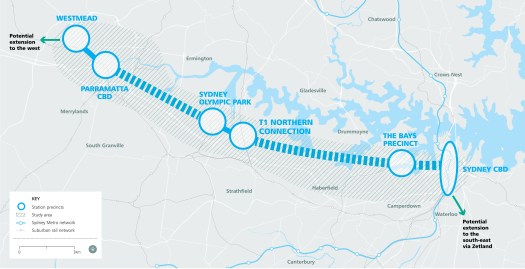
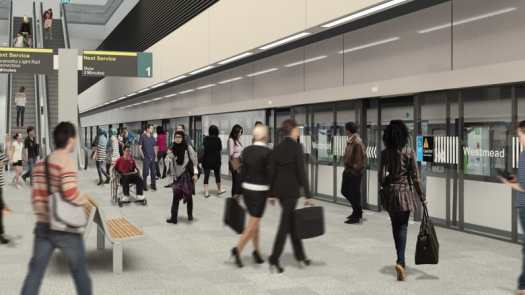
Today the NSW government confirmed that the proposed upcoming Sydney Metro West will include a stop at Westmead. The line will connect the Eastern Harbour City and Central River City in under 20 minutes and provide relief for the existing T1 line.

SydneyMetroWest_map_March2018.jpg

Features of the new Metro include;

  • a new underground metro station at Westmead, to support the growing residential area as well as the health, research and education precinct
  • a new metro station under an existing suburban station on the T1 Northern Line east of Sydney
  • Olympic Park – allowing faster connections for customers from the Central Coast and Sydney’s
  • north to Parramatta and Sydney through a quick and easy interchange between suburban and metro services
  • further consultation on new intermediate metro stations between Parramatta and Sydney
  • Olympic Park and between Olympic Park and the Sydney CBD
  • at least one Sydney Metro West station under the Sydney CBD, delivering an easy interchange between suburban rail, new light rail and the new metro stations currently under construction.
  • It is also proposed that Sydney Metro West will have an underground interchange with an existing suburban station on the T1 Western Line either at Parramatta or Westmead, allowing a fast and easy interchange to metro rail services for customers heading to and from the outer west and Blue Mountains.

The NSW Government will also safeguard the ability to extend Sydney Metro to the south-east of the Sydney CBD towards Malabar via Zetland, serving the Green Square town centre, as well as towards the west beyond Westmead – where one option would be to the new Western Sydney Aerotropolis.

fefb03bba6a6821f7eeaeb63110bbd1928bf1ced

Metrobus March – M90

Route M90 opertates between Burwood and Liverpool via Strathfield, Chullora, Bankstown and Milperra.

IMG_9213.JPG

The former 486 and 860 routes were amalgamated in September 2006 to form a single route 900. In December 2010, the 900 was included in the then Metrobus network and renumbered M90.

The M90 runs every 10 minutes during peak periods, 15 minutes during off-peak weekday periods, and 20 minutes on weekends. It operates between 6am and 8pm daily. Transdev operates the service out of their Bankstown depot using 12.5m buses


First Waratah B-Set

The first of the new Sydney Trains Waratah B-Sets arrived in Sydney today. 24 eight car sets have been ordered and will be used to replace all of the ageing and non-airconditioned S sets. They will  run on the T2, T3 and T8 lines from June.

0f0ffb21bf8b4577b3c30476abcf5450f1b63df6.jpeg

The Waratah B-Set trains will improve customer comfort and accessibility including features such as:

 Improved air conditioning with advanced temperature control.
 More than 90 Internal and external CCTV cameras and two customer help points per car
 Improved accessibility including priority seating, wheelchair spaces and hearing aid loops.
 High definition customer information screens to provide journey and safety information.
 Improved interior LED lighting.

All 24 sets will be in service by late 2019, with an option for a further 45 delivered between 2020 and 2022 if the government is satisfied with the trains performance.

Metrobus March – M61

Route M61 operates between City QVB and Castle Hill via M2 Motorway and Baulkham Hills. It commenced operation on 20 December 2010.

The M61 originally operated through to Railway Square via George Street. Due to construction of the CSELR project, the route was truncated to City QVB from 4 October 2015.

Services on the Castle Hill to CBD corridor began in 1994, with the Route 610 “City Express” via Victoria Road during peak hours. This service was extended to full time operating and re-routed via the then brand new M2 Motorway in 1997. From 2010, all 610 services either became M61 or 610X services. In the 2013 “Sydney’s Bus Future” report, the M61 was designated as a rapid route, with priority to be given in terms of bus priority infrastructure and timetable upgrades.

The M61 operates between 5am and 11pm daily, with all night service on Friday and Saturday. It runs every 10 minutes during peak periods, 15 minutes during off-peak weekday periods, 20 minutes on weekends and hourly overnight The services are operated by CDC HillsBus from their Seven Hills depot using a mix of 14.5m single decker and 12.5m double decker buses.

Future Transport Strategy 2056

Today Minister for Transport and Infrastructure Andrew Constance released the Future Transport Strategy 2056. This strategy allows for commitment  to many major public transport initiatives over the next few decades. These new projects are in addition to this already announced as part of Sydney Metro, Sydney Light Rail and the Western Sydney City Deal.

“By 2056, NSW will have more than 12 million residents and we want to improve public transport and roads so that by 2056, 70 per cent of people live within 30 minutes of where they work or study. For Sydney, people want more public transport projects committed to and work on major projects  started sooner,” Mr Constance said.

In response to feedback, the NSW Government today committed to:

  • Investigate a trial of on demand ferry services following the success of existing on demand bus pilots,
  • Upgrading public transport along Parramatta and Victoria Roads within 10 years,
  • Bring forward investigations into a new bus interchange serving the Western Parklands city around the new Western Sydney Aerotropolis,
  • Improve services along the Richmond rail line and investigate passenger services to the Wilton growth area.

In the longer term, the NSW Government will:

  • Explore the possibility of a rail link between Hurstville and Macquarie Park via Rhodes
  • Improve the connection between Sydney and Western NSW by investigating a solution for crossing the Blue Mountains.
  • Allow for expansion of the light rail network, including extensions to Maroubra and Coogee as well as investigations into new Parramatta light rail lines.
  • Investigate rail links between Greater Parramatta with Epping, and Kogarah via Bankstown as part of a 10 -20 year strategy.
  • Investigate the possibility of an extension of Sydney Metro to the South-East with a line to Malabar from the CBD via Eastlakes and Maroubra
  • A rail link to connect Eastlakes with Sydney Airport, Kogarah and Miranda

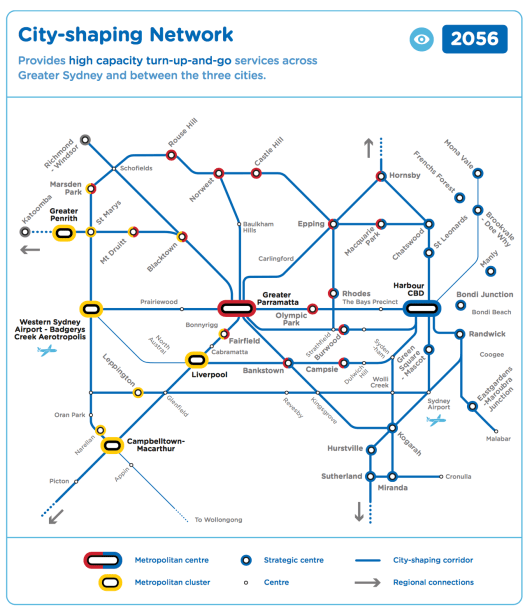
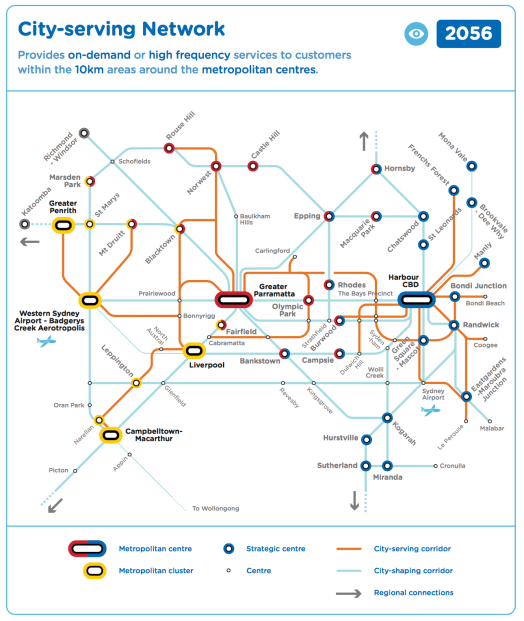
The report has the proposal to implement the projects through the development of  City-Shaping, City-Servcing as well as Centre-Connecting transport networks. The city shaping network will form the backbone of the transport network, with all day frequencies of  5 minute or better.  The City serving network provides high capacity short distance connections to the CBDs with a frequency of 10 minutes or better all day. Centre-connecting services help to ensure that all of services and major centres are connect and run at a high frequency with lower capacity services or on-demand.

Screen Shot 2018-03-20 at 6.32.23 pm.pngScreen Shot 2018-03-20 at 6.32.57 pm.png

Building better connections between Regional centres and nearby communities is also a focus of Future Transport 2056, and traditional infrastructure will be upgraded with a new rail fleet on the way and potential electrification to Bathurst, Goulburn, Nowra and The Hunter.

Metrobus March – M60

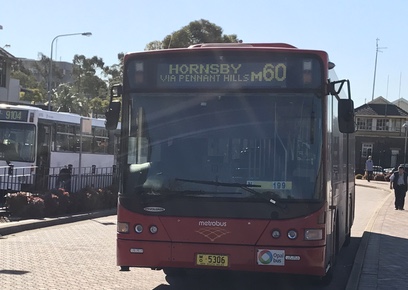
Route M60 operates between Parramatta and Hornsby via Baulkham Hills, Castle Hill, Cherrybrook and Pennant Hills. It commenced operation on 7 March 2011.

Bus services along the current M60 corridor began on February 1 1932, when Parramatta Bus Co Route 200 replaced the Parramatta Tramway between Parramatta and Castle Hill. In 1983, Route 200 was replaced by Route 600 which operated along a similar alignment between Parramatta and Pennant Hills. Route 632 between Hornsby and Castle Hill began operation in June 1995. Both of these routes were operated by CDC Hillsbus until their replacement by Route M60 in March 2011.

In the 2013 “Sydney’s Bus Future” report, the M60 was designated as a rapid route, with priority to be given in terms of bus priority infrastructure and timetable upgrades.

The M61 operates between 6am and 10pm daily, with all night service on Friday and Saturday. It runs every 10 minutes during peak periods, 15 minutes during off-peak weekday periods, 20 minutes on weekends and hourly overnight.

The services are operated out of CDC HillsBus depots in Dural and Seven Hills using a mix of 12.5 and 14.5m buses

fullsizeoutput_7ae


Where Can You Fly? – A380

In today’s edition of Where Can You Fly?, we will be looking at all the different places you can fly from Sydney on the A380.

fullsizeoutput_79c.jpeg

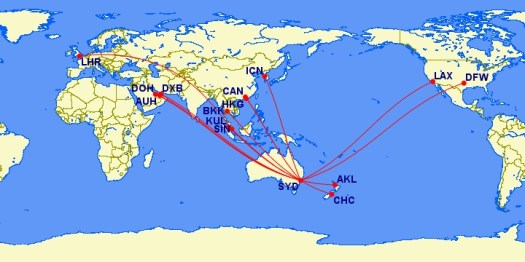
There are 14 different places that you can fly to on the A380 out of Sydney. This includes services on 9 different airlines. Asiana, China Southern, Emirates, Etihad, Korean Air, Malaysia Airlines, Qantas, Qatar and Singapore Airlines all bring their A380s to Sydney.

The inaugural passenger service of the A380 was operated by Singapore Airlines and touched down in Sydney on 27 October 2007 from Singapore becoming the world’s first A380 route. Since then, Sydney has grown to become one of the largest A380 hubs in the world. It is home to the base of 8 Qantas A380s, a major focus city for Emirates A380s and has more airlines using A380s than any other airport.

Where you can fly on the A380;

  • Abu Dhabi – Etihad
  • Auckland – Emirates
  • Bangkok – Emirates
  • Christchurch – Emirates
  • Dallas Fort Worth – Qantas
  • Doha – Qatar
  • Duabi – Emirates
  • Guangzhou – China Southern
  • Hong Kong – Qantas
  • Kuala Lumpur – Malaysia Airlines
  • London – Qantas (via Singapore)
  • Los Angeles – Qantas
  • Seoul – Asiana, Korean Air
  • Singapore – Qantas, Singapore Airlines

fullsizeoutput_79f.jpeg