Sydney Trains “Unworkable Timetable” to be modified from Monday 12 March

The new train timetable that introduced 1500 extra services back in November, is best known for having pushed the network past its limits and into meltdown multiple times.

It has now been revealed that new timetables are being introduced on many lines on 12 March that will roll back some of the extra services and undo some controversial changes.

We can confirm the following changes;

  • T1 North Shore line services between Hornsby and Berorwa before 6am and after 10pm CANCELLED
  • T3 Bankstown line Liverpool express services after 8pm CANCELLED
  • T5 Cumberland line services between Quakers Hill and Richmond and between Liverpool and Leppington on weekend CANCELLED
  • T6 Carlingford line services reduced in frequency on weekends from 30 minutes to 45 minutes
  • Redfern returns as a stop on Blue Mountains Line and will be added on three morning and three afternoon peak services:
    • 05:44 Mount Victoria to Central
    • 06:14 Mount Victoria to Central
    • 06:45 Mount Victoria to Central
    • 16:33 Central to Katoomba
    • 17:03 Central to Katoomba
    • 17:33 Central to Katoomba

The government is insisting that this is a minor timetable tweak and that the services being cut were only carrying fresh air. However it is understood that the real reason is that the timetable has failed and that there are simply not enough trains or drivers to operate all the services required under the timetable. It is hoped that this new timetable will improve reliability and end the woes that the November timetable brought.

Metrobus March – M30

Route M30 is a Metrobus route which operates between Taronga Zoo and Sydenham via Mosman, Sydney CBD, Sydney University and Newtown.

img_6108.jpg

The service originally ran from Spit Junction to Enmore, beginning operation on 28 March 2010. On 25 April 2010, the service was extended to Sydenham as Enmore was consider to be a poor terminus location. From 4 October 2015, the service was changed to operate along Elizabeth Street in the City due to light rail construction on George Street. On 26 November 2017, the M30 was extended to Taronga Zoo.

The M30 runs every 10 minutes during peak periods, 15 minutes during off-peak weekday periods, and 20 minutes on weekends. It operates between 6am and 8pm daily.

The M30 usually operates using articulated “bendy” buses from North Sydney or Tempe depot. These buses are sometimes substituted by 12.5m buses.


Western Sydney City Deal – North South Rail Link & Rapid Bus Network

Today the Australian and NSW government, alongside the eight local councils of Western Sydney, signed the Western Sydney City Deal. It is a 20 year agreement to revitalise western Sydney creating the “Western Parkland City”.

fullsizeoutput_7bc

The deal involves commitments to connectivity and transport, connecting the Western City by world-class road, rail, aviation and digital infrastructure.

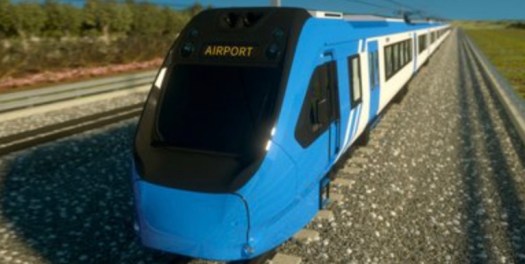
The centrepiece of the Western Sydney City Deal is the first stage of the North-South Rail Link between St Mary and Western Sydney Aerotropolis via Western Sydney Airport.

Eventually a new Western Sydney Rail network will be built, creating a North-South rail link between Rouse Hill and Macarthur via Western Sydney Aerotropolis, a East-West Rail Link between Western Sydney Aerotropolis and Sydney CBD via Parramatta as well as an extension of the South-West rail link from Leppington to Western Sydney Aerotropolis via Bringelly.

There will also be the development of a new Rapid Bus network, connecting Campbelltown, Liverpool and Penrith with Western Sydney Aerotropolis via Western Sydney Airport.

This will allow for the development of a major transport interchange between rail and bus at the new Western Sydney Aerotropolis. The Western Sydney Aerotropolis become a world class city precinct and the Western City’s newest commercial and industrial hub, with thousands of jobs. The area will bring together transport, communications and logistics and attract new growth in industries such as aerospace and defence industries, health, education and tourism.fullsizeoutput_7bd

Where Can You Fly? – USA

This edition of Where Can You Fly, we are looking at all the US routes out of Sydney.

The US is one one of the most popular destinations out of Sydney, with loads of both Aussies and Americans traveling between the two everyday.

There is a long history of direct flights to the US from Sydney, staring with Qantas original Sydney – Honolulu – San Francisco flights on the 707 back in the 1960s, moving forward to direct flights to the 48 contiguous states on the 747 in the 1980s, through to the network we see today.

You can fly direct between 5 US cities in three different states. Onwards same plane connections exist to a sixth.  the most popular route is to LA, with nearly 40 weekly flights.

American Airlines, Delta, Hawaiian Airlines, Qantas, Virgin Australia and United all fly between Sydney and the US, with Qantas undoubtedly being the largest carrier controlling 2/3 of the Sydney-US market, followed by United which has around 20% of the market.

Qantas flies a mix of A380 and 747 aircraft between Sydney and the US. Both American and United use 787 aircraft, whilst Delta and Virgin Australia offer the 777.

map
Routes from Sydney to the US

The routes are;

  • Dallas Fort Worth – Qantas
  • Honolulu – Hawaiian, Qantas
  • Houston – United
  • Los Angeles – American Airlines, Delta, Qantas, Virgin Australia, United
  • New York JFK – Qantas (same plane via LAX)
  • San Francisco – Qantas, United

Trial of Real Time Data Displays

Transport for NSW and State Transit are currently conducting trial of two E-Ink Papercast Real Time Data displays. They have been installed at Town Hall Stand K and QVB Stand B.

These displays provide real time schedules and capacity levels on upcoming services.  They also have space for service alerts to let customers know about delays, service alterations, all stop boarding amongst other things.

It is hoped that if the trial is successful that these signs will be able to be rolled out to more bus stops, initially in the Sydney CBD and then into major centres.

The displays are powered by solar panels and take up as much space as current model bus signage, making them a suitable alternative to existing hard paper signage

Metrobus March – M20

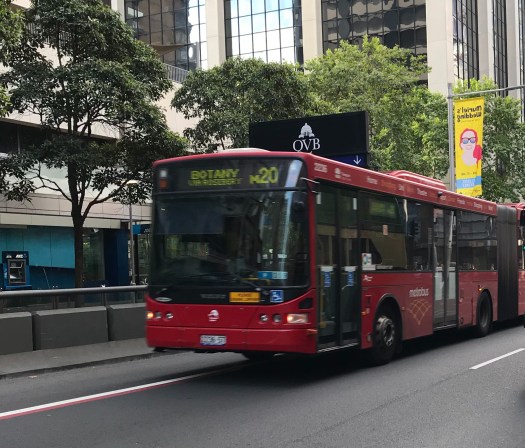
The M20 is a Metrobus route that operates between Gore Hill and Botany via North Sydney, Sydney CBD, Rosebery and Mascot.

IMG_5521

The route was initially intended to run from Lane Cove Interchange to Sydney Airport, however disagreements with both Lane Cove Council and Sydney Airport forced the termini to be located in Gore Hill and Mascot instead.

Services commenced on 26 October 2009 between Gore Hill and Mascot as the second Metrobus route. From 27 February 2011 the service was extended to Botany Shops.

The M20 has been the most successful Metrobus service, with the route experiencing passenger displacement during peak hours, particularly on the inner southern portion of the route through densely populated Surry Hills, Waterloo and Zetland. This led to short runnings of the service during peak hour and after existing operating hours between City Wynyard and Zetland beginning on 4 October 2015.

Services operate along the entire length of the route between 6am and 8pm daily. Frequencies vary from 10 minutes during peak, 15 minutes off peak and 20 minutes on weekends. Between City Wynyard and Zetland the service operates between 4am and Midnight, with a frequency of 5 minutes in peak hour, 15 minutes off peak, 20 minutes on weekends and late at night.

The service is predominantly operated using articulated “bendy” buses from Port Botany and Tempe depot. Some late night services use standard 12.5m buses from Tempe.

Metrobus March – M10 (Featured Bus Route – March 2018)

Metrobus is an Australian high frequency, high capacity bus network in Sydney that links key employment and growth centres. There are 13 routes with all route numbers are prefixed with an “M” followed by 2 numbers. There are three Metrobus operators, STA with routes M10-M54, Hillsbus with routes M60-M61 and Transdev with routes M90-M92.

13 Routes, 13 Posts, This March we will be featuring all the Metrobus routes, starting today by revisiting the M10 which we previously looked at.

The M10 runs from Maroubra to Leichhardt via UNSW, Taylor Square, Central Station and Parramatta Road

cropped-fullsizeoutput_788-e1518929244103.jpeg

Route M10 was the original route in the Metrobus network, launched on 12 October 2008. It was part of an attempt to provide a bus rapid transit network in Sydney providing an increase in services on busy corridors and also to reduce the number of buses terminating in the CBD where lay-over space is limited.

It initally ran from Kingsford to Leichhardt Marketplace via Town Hall howver the route has had numerous modifications. In 2009 the the route was changed to Maroubra Junction to Leichhardt Town Hall due to availability of suitable bus stops and layover space, in 2011 it was extended to Leichhardt Pioneer Park. In 2015, the part of the route via Town Hall was removed from the route due to the construction on the CSELR.

The service runs every 10 minutes during peak hour, every 15 minutes off peak and every 20 minutes at night and on weekends. The hours of operation are from 6am-8pm daily.

The service is operated by a fleet of Volgren or Custom Coaches bodied Volvo B12BLEA articulated buses from Leichhardt and Port Botany depots.

Guest Questions – Summer 2018

With the return to more regular posting over Summer, we have received many questions that we are going to answer for you today. If you want to know anything about Transport in NSW, please ask us! We always respond straight way (no waiting for the post) and really love hearing from you. We have decided to keep names anonymous.

What are the bus regions?

The bus regions refer to the Sydney Metropolitan Bus Contract regions that are used to determine what bus operator is to operate a particular route. They are numbered 1 through 15.

Will my region (Region 7) be privatised?

No. At this time Regions 7-9 will continue to be operated by government owned STA. Only Region 6 is changing hands at this time.

Is the light rail really that late? How can the issues they have had make the project that late?

Yes, the light rail is running THAT late. The progress you are seeing now is actually where the project should have been a year ago. It is a mixture of poor planning, poor workmanship and over-engineering of a simple project.

Can you look at where we can fly on specific planes – like the A380 or 747?

Most certainly! Look out for those in upcoming “Where Can You Fly?” segments.

Can you please do a feature of Leichhardt Bus Depot and Region 6 privatisation?

Of course. In fact, its already up on this link. More region 6 privatisation posts can be found under “Farewell Region 6

How do buses on the 370 always bunch up?

The 370 is a very long and complex route, buses can get caught up at traffic lights or in slow moving traffic. Once one bus is late, it begins to pick up more passengers and the bus behind picks up less making is faster, which often brings the buses together. The 370 also has new buses forming from the depot at each end regularly, if one bus already in the cycle but an on-time bus from the depot comes at the same time, they can often end up together as well.

When is Macquarie Park Station closing?

At this point, no date has been given for the ECRL closure. It is likely to be in the second half of this year.

What Bus apps do you use?

I have three apps that I use.

  1. TripView – for viewing individual routes that I take often. I use this as my everyday real time app.
  2. NextThere – for viewing all the upcoming services at a stop. Perfect for working out what is the right route to catch from your nearest stop.
  3. AnyTrip – To see what buses are in the network and what they are operating. My favourite for finding the Christmas or special livery buses.

Farewell Region 6 – Burwood Depot

Today as part of our series farewelling STA region 6 before it transfers to Transit Systems on July 1 we are looking at Burwood Depot.

Burwood Depot was the first depot to be government owned in Region 6, when it was purchased from the Metropolitan Omnibus Transport Company by the Department of Road Transport & Tramways to allow it to open up services in the Inner West. The initial bus repair cavities were located at Burwood depot until they were moved to Leichhardt in 1935.

The first service operated from Burwood depot o. 27 January 1933, Route 59 from Concord to City York Street. Dozens of routes started within the first few years of operation.

Today there are 104 buses in the fleet at Burwood depot, made up of Volvo B12BLE Euro 5 buses with CB60 Evo II bodywork and Volvo B10BLE with Orana bodywork.

Some major routes operated out of Burwood depot include the M41 and 461.

On the last Sunday of each month through to June 24 we will be doing another edition of Farewell Region 6. On July 1st which is the first day of the new operator, we will be on the scene with an update to the changeover.

Ferry McFerryFace to be renamed

Summer is nearly over and that means that Ferry McFerryFace will soon be a thing of the past.

The controversial name is set to be replaced with that of children’s author May Gibbs in the coming weeks. This fits in with the governments commitment to keep the name meaningful for kids.

It was revealed earlier this year that the Transport Minister Andrew Constance mislead the public over how popular the name Ferry McFerryFace actually was, claiming it was the number one choice despite it only getting 200 votes out of over 10 000.

cropped-img_7206.jpg
Ferry McFerryFace during more happier times