Sydney Metro West to Westmead

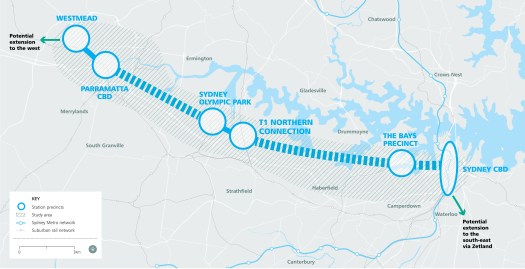
Today the NSW government confirmed that the proposed upcoming Sydney Metro West will include a stop at Westmead. The line will connect the Eastern Harbour City and Central River City in under 20 minutes and provide relief for the existing T1 line.
SydneyMetroWest_map_March2018.jpg

Features of the new Metro include;

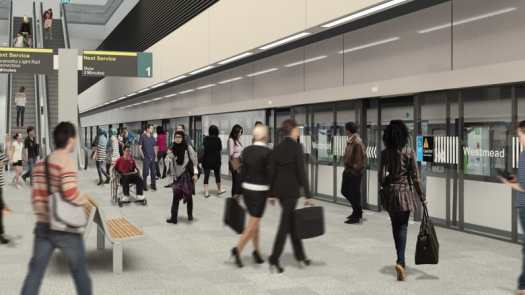
  • a new underground metro station at Westmead, to support the growing residential area as well as the health, research and education precinct
  • a new metro station under an existing suburban station on the T1 Northern Line east of Sydney
  • Olympic Park – allowing faster connections for customers from the Central Coast and Sydney’s
  • north to Parramatta and Sydney through a quick and easy interchange between suburban and metro services
  • further consultation on new intermediate metro stations between Parramatta and Sydney
  • Olympic Park and between Olympic Park and the Sydney CBD
  • at least one Sydney Metro West station under the Sydney CBD, delivering an easy interchange between suburban rail, new light rail and the new metro stations currently under construction.
  • It is also proposed that Sydney Metro West will have an underground interchange with an existing suburban station on the T1 Western Line either at Parramatta or Westmead, allowing a fast and easy interchange to metro rail services for customers heading to and from the outer west and Blue Mountains.

The NSW Government will also safeguard the ability to extend Sydney Metro to the south-east of the Sydney CBD towards Malabar via Zetland, serving the Green Square town centre, as well as towards the west beyond Westmead – where one option would be to the new Western Sydney Aerotropolis.
fefb03bba6a6821f7eeaeb63110bbd1928bf1ced

First Waratah B-Set

The first of the new Sydney Trains Waratah B-Sets arrived in Sydney today. 24 eight car sets have been ordered and will be used to replace all of the ageing and non-airconditioned S sets. They will  run on the T2, T3 and T8 lines from June.

0f0ffb21bf8b4577b3c30476abcf5450f1b63df6.jpeg

The Waratah B-Set trains will improve customer comfort and accessibility including features such as:

 Improved air conditioning with advanced temperature control.
 More than 90 Internal and external CCTV cameras and two customer help points per car
 Improved accessibility including priority seating, wheelchair spaces and hearing aid loops.
 High definition customer information screens to provide journey and safety information.
 Improved interior LED lighting.

All 24 sets will be in service by late 2019, with an option for a further 45 delivered between 2020 and 2022 if the government is satisfied with the trains performance.

Future Transport Strategy 2056

Today Minister for Transport and Infrastructure Andrew Constance released the Future Transport Strategy 2056. This strategy allows for commitment  to many major public transport initiatives over the next few decades. These new projects are in addition to this already announced as part of Sydney Metro, Sydney Light Rail and the Western Sydney City Deal.

“By 2056, NSW will have more than 12 million residents and we want to improve public transport and roads so that by 2056, 70 per cent of people live within 30 minutes of where they work or study. For Sydney, people want more public transport projects committed to and work on major projects  started sooner,” Mr Constance said.

In response to feedback, the NSW Government today committed to:

  • Investigate a trial of on demand ferry services following the success of existing on demand bus pilots,
  • Upgrading public transport along Parramatta and Victoria Roads within 10 years,
  • Bring forward investigations into a new bus interchange serving the Western Parklands city around the new Western Sydney Aerotropolis,
  • Improve services along the Richmond rail line and investigate passenger services to the Wilton growth area.

In the longer term, the NSW Government will:

  • Explore the possibility of a rail link between Hurstville and Macquarie Park via Rhodes
  • Improve the connection between Sydney and Western NSW by investigating a solution for crossing the Blue Mountains.
  • Allow for expansion of the light rail network, including extensions to Maroubra and Coogee as well as investigations into new Parramatta light rail lines.
  • Investigate rail links between Greater Parramatta with Epping, and Kogarah via Bankstown as part of a 10 -20 year strategy.
  • Investigate the possibility of an extension of Sydney Metro to the South-East with a line to Malabar from the CBD via Eastlakes and Maroubra
  • A rail link to connect Eastlakes with Sydney Airport, Kogarah and Miranda

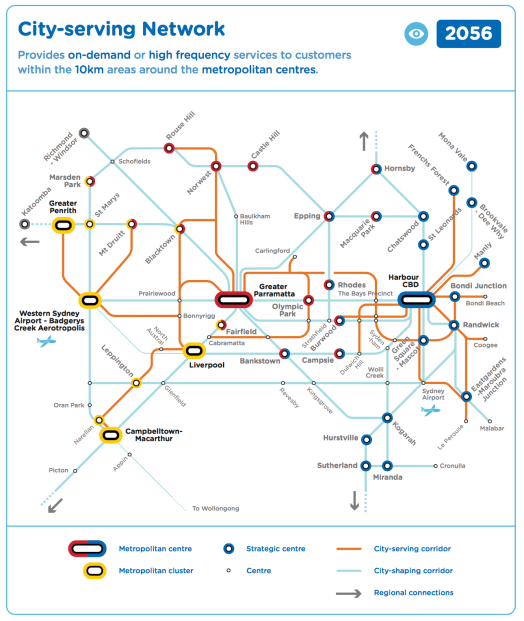
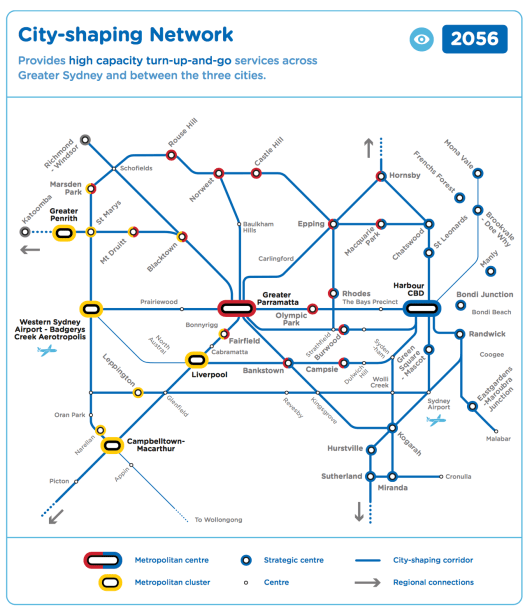
The report has the proposal to implement the projects through the development of  City-Shaping, City-Servcing as well as Centre-Connecting transport networks. The city shaping network will form the backbone of the transport network, with all day frequencies of  5 minute or better.  The City serving network provides high capacity short distance connections to the CBDs with a frequency of 10 minutes or better all day. Centre-connecting services help to ensure that all of services and major centres are connect and run at a high frequency with lower capacity services or on-demand.

Screen Shot 2018-03-20 at 6.32.23 pm.pngScreen Shot 2018-03-20 at 6.32.57 pm.png

Building better connections between Regional centres and nearby communities is also a focus of Future Transport 2056, and traditional infrastructure will be upgraded with a new rail fleet on the way and potential electrification to Bathurst, Goulburn, Nowra and The Hunter.

Unpopular Fixed Seating for New Intercity Trains

23a55d63368e3adbb7de03a9e88d1729bf9177f8

The troubled project to introduce new $2.3 billion intercity trains to Sydney’s rail network has recently  been further criticised due to the decision to install fixed rather than reversible seating.

The two-by-two fixed seats on the new train will mean that half of all passenger will travel backwards. It is understood that at each end and in the middle of the carriage, four seats will be placed together in a group, whilst all other seats would be in fixed twos, half forwards and half backwards.

5fc6b43435ac9496a888d475d943af938e830aa1

This decision was made  despite government documents showing an overwhelming preference for reversible seating over fixed seating. There is a perception that this change is a backwards step.

The reason for this decisions is that there is no proven design solution for reversible seating that meets safety requirements. That lack of design would place the timeline for the delivery of the new trains “at risk”.

The transport agency said the new intercity trains had been designed with passenger comfort in mind. “We’ve asked customers what they value and incorporated much of this feedback into the design, including two-by-two seating with wider seats, arm rests and wider aisles, as well as amenities like tray tables and charging outlets for mobile devices,” a spokesman said.

 Labor’s transport spokeswoman, Jodi McKay, said travelling backwards was “just not an option” for passengers who suffered motion sickness. “The journey for some intercity passengers can be up to three hours – that’s a long time to sit backwards or be forced to stand,’

The first of the new trains will begin services late next year to the Central Coast and Newcastle. The government expects the new trains to begin running on the Blue Mountains Line to Mount Victoria in mid-2020, followed by Lithgow about four months later. After that, the trains will start carrying passengers on the South Coast Line to Wollongong and Kiama.

New Regional Coach Links

NSW TrainLink plans to trial new coach connections to better connect regional communities. Each trial aims to provide new connections for regional communities, whether it be for commuters, people attending medical or business appointments, shopping trips, recreational activities or to catch up with family and friends.

These services will provide new links between:

  • Tamworth and Newcastle
  • Tamworth and Dubbo
  • Tamworth and Port Macquarie
  • Wagga Wagga and Albury
  • Goulburn and Sydney
  • Goulburn and Canberra

The trial of the new connections between Tamworth and Newcastle, Dubbo and Port Macquarie started on March 12 2018.

NSW TrainLink is currently seeking feedback on the proposed trials between Wagga Wagga and Albury, Goulburn and Sydney and between Goulburn and Canberra here.


Contactless Payment expanded to all Sydney Ferries, Light Rail

From Today you can pay your fare on any Sydney Ferries or light rail service using a contactless card.

fullsizeoutput_9e4

This service has been trialled on the F1 Manly Ferry line and deemed to be a success, with the service being popular amongst tourists and one-off travellers.

You can tap on and tap off at an Opal card reader to pay your fare using most American Express, Mastercard and Visa cards, plus mobile wallets on smartphones, tablets and watches. Fares are the same as an Adult Opal single trip ticket.

You can only use your card or device to tap on for one fare per trip. You cannot pass the card back to someone else to pay a second fare.

Contactless payment will be available at 57 destinations across Sydney including any popular tourist destinations such as Circular Quay, Darling Harbour, Manly, Star Casino and Taronga Zoo.


Sydney Trains “Unworkable Timetable” to be modified from Monday 12 March

The new train timetable that introduced 1500 extra services back in November, is best known for having pushed the network past its limits and into meltdown multiple times.

It has now been revealed that new timetables are being introduced on many lines on 12 March that will roll back some of the extra services and undo some controversial changes.

We can confirm the following changes;

  • T1 North Shore line services between Hornsby and Berorwa before 6am and after 10pm CANCELLED
  • T3 Bankstown line Liverpool express services after 8pm CANCELLED
  • T5 Cumberland line services between Quakers Hill and Richmond and between Liverpool and Leppington on weekend CANCELLED
  • T6 Carlingford line services reduced in frequency on weekends from 30 minutes to 45 minutes
  • Redfern returns as a stop on Blue Mountains Line and will be added on three morning and three afternoon peak services:
    • 05:44 Mount Victoria to Central
    • 06:14 Mount Victoria to Central
    • 06:45 Mount Victoria to Central
    • 16:33 Central to Katoomba
    • 17:03 Central to Katoomba
    • 17:33 Central to Katoomba

The government is insisting that this is a minor timetable tweak and that the services being cut were only carrying fresh air. However it is understood that the real reason is that the timetable has failed and that there are simply not enough trains or drivers to operate all the services required under the timetable. It is hoped that this new timetable will improve reliability and end the woes that the November timetable brought.

Western Sydney City Deal – North South Rail Link & Rapid Bus Network

Today the Australian and NSW government, alongside the eight local councils of Western Sydney, signed the Western Sydney City Deal. It is a 20 year agreement to revitalise western Sydney creating the “Western Parkland City”.

fullsizeoutput_7bc

The deal involves commitments to connectivity and transport, connecting the Western City by world-class road, rail, aviation and digital infrastructure.

The centrepiece of the Western Sydney City Deal is the first stage of the North-South Rail Link between St Mary and Western Sydney Aerotropolis via Western Sydney Airport.

Eventually a new Western Sydney Rail network will be built, creating a North-South rail link between Rouse Hill and Macarthur via Western Sydney Aerotropolis, a East-West Rail Link between Western Sydney Aerotropolis and Sydney CBD via Parramatta as well as an extension of the South-West rail link from Leppington to Western Sydney Aerotropolis via Bringelly.

There will also be the development of a new Rapid Bus network, connecting Campbelltown, Liverpool and Penrith with Western Sydney Aerotropolis via Western Sydney Airport.

This will allow for the development of a major transport interchange between rail and bus at the new Western Sydney Aerotropolis. The Western Sydney Aerotropolis become a world class city precinct and the Western City’s newest commercial and industrial hub, with thousands of jobs. The area will bring together transport, communications and logistics and attract new growth in industries such as aerospace and defence industries, health, education and tourism.fullsizeoutput_7bd
Trial of Real Time Data Displays

Transport for NSW and State Transit are currently conducting trial of two E-Ink Papercast Real Time Data displays. They have been installed at Town Hall Stand K and QVB Stand B.

These displays provide real time schedules and capacity levels on upcoming services.  They also have space for service alerts to let customers know about delays, service alterations, all stop boarding amongst other things.

It is hoped that if the trial is successful that these signs will be able to be rolled out to more bus stops, initially in the Sydney CBD and then into major centres.

The displays are powered by solar panels and take up as much space as current model bus signage, making them a suitable alternative to existing hard paper signage

Ferry McFerryFace to be renamed

Summer is nearly over and that means that Ferry McFerryFace will soon be a thing of the past.

The controversial name is set to be replaced with that of children’s author May Gibbs in the coming weeks. This fits in with the governments commitment to keep the name meaningful for kids.

It was revealed earlier this year that the Transport Minister Andrew Constance mislead the public over how popular the name Ferry McFerryFace actually was, claiming it was the number one choice despite it only getting 200 votes out of over 10 000.

cropped-img_7206.jpg
Ferry McFerryFace during more happier times