South-East Bus commuters got a first look at their bus network today, after confidential plans containing the proposal was leaked overnight. These changes are being introduced due to the opening of the CBD and South East Light Rail, in order to reduce service duplication between the tram and the bus network. The proposed changes will begin at some point after the L3 Kingsford Line of the light rail network opens later this month.
South-East bus commuters are in for a shake-up of their network from later this year – Transport NSW Blog Collection
It is important to note that this confidential document is a draft document of the changes ONLY and is subject to change. Transport NSW Blog has confirmed the validity of the document with internal sources, which they say is mostly final, but do warn that some changes may occur. Transport NSW Blog has been made aware that an official announcement is to be expected later this week and it is believed that the leak was deliberate leak.
A full list of known changes is listed below;
NEW ROUTES
319 – Maroubra Beach to Bondi Junction via Oberon Street, Randwick Junction and Charing Cross
375 – Coogee Beach to Railway Square via Randwick Junction, Moore Park and Taylor Square
390 – Coogee Beach to La Perouse via Randwick Junction, Kingsford and Maroubra Junction
398 – Clovelly Beach to La Perouse via Randwick Junction, Maroubra Junction and Malabar Heights
CHANGED ROUTES
348 – Wolli Creek to Bondi Junction changed to operate via High Street in both directions
370 – Coogee Beach to Leichhardt changed to operate via High Street in both directions
373 – Coogee Beach to Circular Quay becomes overnight only 373N Coogee Beach to Circular Quay via Taylor Square (11pm – 6am ONLY)
391 – La Perouse to Railway Square becomes La Perouse to Kingsford via Bunnerong Road
392 – Little Bay to Circular Quay becomes Little Bay to Redfern via Bunnerong Road, Kingsford and Green Square
394 – La Perouse to Circular Quay becomes overnight only 394N La Perouse to Circular Quay via Taylor Square (11pm – 6am ONLY)
400 – Bondi Junction to Sydney Airport changed to operate via High Street in both directions
All express routes will move to a four digit route number, but will be retained
X39 becomes 339X
X40 becomes 341X
X73 becomes 373X – potential for minor stopping pattern changes
X74 becomes 374X
X77 becomes 377X – potential for minor stopping pattern changes
X92 becomes 392X
X93 becomes 393X – potential for minor stopping pattern changes
At this stage it is unknown if the following routes will have any changes, however that they were included within the scope of the new bus network plan.
From Sunday 9 February, there will be changes to some bus routes and adjustments to other services across the Inner West. There will also be minor timetable changes to North Shore and Northern Beaches bus services.
CHANGES TO INNER WEST SERVICES
M10
Route changed to operate via Haymarket light rail/bus interchange for journeys towards Leichhardt
All services towards Leichhardt will operate via Elizabeth Street, Eddy Avenue, Rawson Place and George Street, and will no longer stop at Pitt St opp Barlow St
Changes to weekday trip times to support more reliable journeys
M20
Route renumbered to 320
Route withdrawn between Botany Shops and Mascot Shops to reduce service duplication, reflect customer demand and support more reliable journeys. Alternative travel options between Botany Shops and Mascot Shops include routes 309, 309X and 310X.
Changes to weekday trip times to support more reliable journeys
M30
Route renumbered to 430
Changes to weekday trip times to support more reliable journeys
The last two weekday evening trips from Sydenham towards Mosman will be changed to operate to Spit Junction only
420
Changes to weekday trip times to support more reliable journeys
An additional trip will be introduced on early weekday mornings departing Rockdale towards Eastgardens
440
Route changed to operate via Haymarket light rail/bus interchange for journeys towards Leichhardt
All services towards Leichhardt will operate via Elizabeth Street, Eddy Avenue, Rawson Place and George Street, and will no longer stop at Pitt St opp Barlow St
Changes to weekday trip times to support more reliable journeys
470
Changes to weekday trip times to support more reliable journeys
An additional trip will be introduced on weekday evenings departing Martin Place towards Lilyfield
487
Route 487 will be changed to operate via Canarys Road, Violet Street and Mount Avenue instead of Canterbury Road and King Georges Road to and from Roselands (early morning weekday trips not currently operating via Roselands will continue to operate via Canterbury Road direct)
Changes to weekday trip times to support more reliable journeys
Other services that will receive minor changes include;
To all of our readers, Transport NSW Blog would like to wish you a very Merry Christmas and a Happy New Year. Thanks for an another great year hear at the blog and for your continued support. We look forward to continuing to post the latest transport news, photos and “featured bus routes” in 2020.
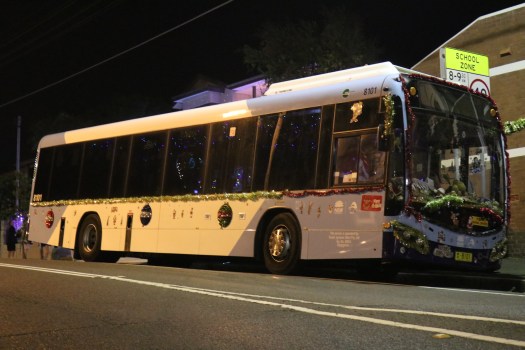
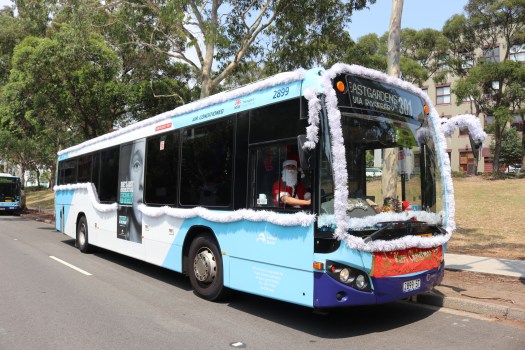
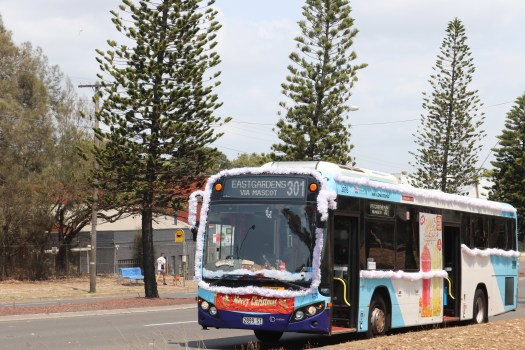
Santa aboard State Transit Port Botany Christmas Bus – Transport NSW Blog Collection
Many thanks to Adam Stevens of Transit Systems and Norbert Genci and Joshua Power of State Transit for helping us get photos of two of this years Christmas Buses.
Transit Systems Kingsgrove Christmas Bus in North Bondi – Transport NSW Blog CollectionTransit Systems Kingsgrove Christmas Bus in Clovelly – Transport NSW Blog CollectionSanta Driving State Transit Port Botany Christmas bus in Redfern – Transport NSW Blog CollectionState Transit Port Botany Christmas bus in Pagewood – Transport NSW Blog Collection
Saturday marked the opening of the new L2 Randwick Line of the Sydney Light Rail network, as the first stage of the CBD and South East light rail project. Despite getting off to a smooth start at 10am, it wasn’t long before the day was derailed by a long string of unfortunate events that put a dampener on festivities.
The L2 Randwick Line opened on Saturday, but was marred by a series of failures – Transport NSW Blog Collection
The line is timetabled to take around 45 minutes from Circular Quay to Randwick, with the trip taking 20 minutes from Circular Quay to Central and another 25 minutes between Central and Randwick. This is an improvement from the rumoured 51 minute travel times before the opening, but is much slower than the initially promised faster than the buses trip, which would require a sub 35 minute travel time.
On opening day, it was taking around 55 minutes for the non disrupted services to travel the route. Despite this, there were reports that some services took nearly two hours to travel between Randwick and Circular Quay and that a number of services held passengers hostage between stops for up to 45 minutes. These extra long travel times are hopefully just anomaly that can be put down to teething problems and shouldn’t be experienced in revenue service.
There were a significant number of problems that all seemed to compound on Saturday afternoon, leading to many passengers dubbing the system “Sydney Light Fail” and even spawning a satirical twitter account. The delays included:
Tram suffers electrical failure at Royal Randwick. Blocks tracks for 10 minutes.
Passenger suffers stroke on tram at Haymarket. Tram taken out of service for cleaning, blocks tracks for 40 minutes.
Tram suffers break and traction failure on Crossovers at Circular Quay, blocking all three platforms. Trams truncated to Town Hall for 90 minutes. Passengers trapped between stations for over 45 minutes.
Signalling problems at Town Hall forces every second tram to terminate at Central for an hour.
Randwick Terminus overwhelmed with trams forces trams to terminate at UNSW High Street. Up to 3 trams waiting along High Street to access Randwick terminus
Tram dwell times at stops in excess of 10 minutes due to signalling failures and headway problems.
A tram broke down, blocking all three sets of tracks at Circular Quay – Transport NSW Blog Collection
All of these problems compounded to create quite an embarrassing situation for the government. This led Transport Minister Andrew Constance to compare the days dilemma as akin to “giving birth to child” and suggested that “birthing pains” were to be expected. This appears to be a pattern for new transport openings, given that Sydney Metro also suffered a series of problems on its opening day.
The line appeared to operate more trouble free on Sunday, with consistent travel times of around 50 minutes from end to end, which appears to again have been decreased to 45 minutes in the Monday AM peak hour. The government and the operate have both promised to work on providing a sub-40 minute travel time once the L3 Kingsford line opens in March and the service is fully bedded down.
The sub 40 minute travel time promise will be disappointing to thousands of South East commuters travelling through Randwick to the CBD each day. To be quicker than the slowest Randwick to Circular Quay bus in the peak, the line needs to be achieving a sub-35 minute travel time. Once you factor in people connecting from feeder buses, the line realistically needs to travel between Circular Quay and Randwick in around 30 minutes. This is achievable based on observations of similar tram lines around the world, but will need some will from the private operator. Transport Minister Andrew Constance has stated that be expects the trams to get faster “I would hope they will start to speed up as people get used to them but it’s not going to happen on day dot,” he said. “People need to get used to pressing the buttons on the doors – it’s not like a bus.”
Transport Minister Andrew Constance expects trips from Circular Quay to “speed up as people get used to them” – Transport NSW Blog Collection
If the tram line genuinely cannot be faster than the bus services it is designed to replace, then we need to take a hard look at the business case itself. Is the line economically viable if it is not going to be able to convince bus passengers to transfer at Randwick? Who is actually going to catch such a slow tram? The line will fail at its main objectives of reducing bus traffic into the city and providing a faster and more comfortable journey between the South East and CBD. Given the significant cost over runs, the people surely would expect to get what they were promised, and not the slowest tram network in Australia and one of the slowest in the world. Labor’s transport spokesman, Chris Minns, said people would be “scratching their heads wondering why $3 billion has been spent on a project that is so slow. When you consider it’s quicker to get from Penrith to the city, than from Randwick to the city, you have a major problem,”
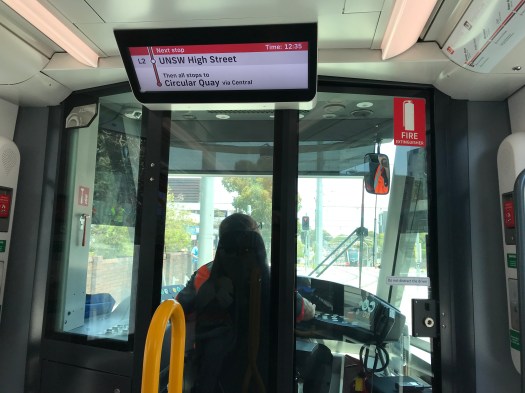
The one place this line needs to succeed even if it fails at everything else is operating counter peak journeys to UNSW. Replacing the current dedicated express services was one of the major justifications for the construction of the line. Currently it takes around 20 minutes on the 891 bus between Central and UNSW. Under the current tram timetable, the journey between Central and UNSW would take 22 minutes by tram. This is comparable, but hopefully should be improved on as time goes on as we reach a sub 40 minute travel time end to end. If the line can get between Central and UNSW in less than 20 minutes, then on that front the line could be successful.
Travel times between UNSW and Central need to be the same, if not faster than the existing buses to attract Uni students – Transport NSW Blog Collection
We probably need to wait until the entire CBD and South East light rail network is open, and people are used to catching and being around trams before making a final judgement on the success of the line. Early problems for Sydney Metro haven’t stopped it from becoming a runaway success. If travel times can be reduced significantly to make the line competitive with bus travel and the teething problems can be ironed out, then this line could end up proving highly successful. If not? We have over 3 billion reasons to get rid of this government, just like the locals along the line did to their local Liberal MPs in frustration over the problematic construction that has disrupted the past 4 years of their life. The locals of the South East deserve something that works, lets hope they’ve got it!
Its Official! The new South East Light Rail opens 14 December 2019, with services on the L2 Randwick Line beginning from 11am.
Light Rail Services begin 14 December 2019 – Transport NSW Blog Collection
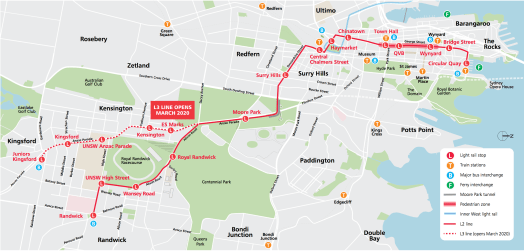
The L2 Randwick Line includes 14 stops between Circular Quay and Randwick, running through the CBD, Central, Surry Hills, Moore Park, UNSW and ending at the Randwick Hospitals Campus on High Street, Randwick. The L3 Kingsford Line will open in March 2020, adding five more stops between Moore Park and Kingsford at Nine Ways. Additional services will run from Central Chalmers Street Stop for major events to Moore Park and Royal Randwick Racecourse.
Map of the new line – Transport for NSW
Services start from 5am and end at 1am each day, and run more frequently on weekdays between 7am and 7pm with services every 4 to 8 minutes between Circular Quay and Central, and every 8 to 12 minutes between Central and Randwick. At 67-metres long, the light rail can carry up to 450 people at once. This makes them some of the highest capacity tram services in the world.
The new light rail will run fare free on the first weekend with the first services starting around 11am Saturday 14 morning. The fare free weekend (Saturday 14 and Sunday 15 December) only applies to the L2 Randwick line, not the existing L1 Inner West line or other public transport services.
On weekdays, frequent services will run approximately every four to eight minutes between Circular Quay and Central, and every eight to twelve minutes between Central and Randwick, from 7am to 7pm as we bed in services over the next six months.
As part of the NSW government’s ‘Regional Cities Program’, there are plans to improve or increase bus services right across regional NSW. All 16 cities participating in the program will receive greatly improved transport services.
Bus services across 16 major regional centres will be improved under the Regional Cities Program – Transport NSW Blog Collection
The program aims to identify gaps and opportunities with current bus services in each city and deliver improvements to better meet customer needs.
Improvements that have been suggested for implantation as part of the program include;
Changes to existing journeys and timetables,
New trip possibilities including new routes,
Extended service hours including later services during evenings and all day service on weekends
More reliable services and better connections to where people work, shop, study and access health care and other services.
Where applicable, the program will also look at more seamless journeys across State borders.
The new bus services will be piloted in Tweed Heads and Wagga Wagga, with new services launching in Tweed Heads from Monday 16 December 2019.
Minister for Regional Transport and Roads Paul Toole said the new timetables would deliver improved connectivity to popular locations and would see longer operating hours along key routes.
“The NSW Liberals & Nationals Government is delivering on its election commitment to improve bus services in 16 Regional Cities, with the Tweed the first to receive a major public transport boost,” Mr Toole said.
“We are supporting economic growth in our regions by improving connectivity, employment opportunities, education facilities and leading health care services.
“As we support and grow our hubs, it’s important we have the services available that meet customers’ needs. The new Tweed network will serve as a pilot program for further improvements to other regional cities.”
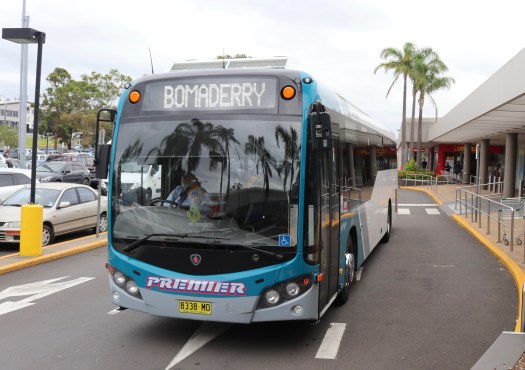
The other regional cities involved in the scheme are Griffith, Bathurst, Orange, Dubbo, Parkes, Port Macquarie, Coffs Harbour, Grafton, Albury, Nowra-Bomaderry, Queanbeyan, Tamworth, Armidale and Lismore.
The existing bus operators in the area will received additional assistance funding for the provision of these new services. This may include new buses, and money for additional driver salaries.
State Transit’s Scania L113TRB Ansair Orana fleet is now in the final stage of its retirement, with just 3 buses left in service and a planned final withdrawal in early December. These buses, affectionately referred to as the ‘long bus” and “14.5s” have been driving around Sydney for over 26 years, but alas, all good things must come to an end.
From Sunday 17 November 2019, changes to bus services will be introduced in Sydney’s North West and Northern Beaches.
These changes will provide more reliable journeys and easier connections to Metro stations at including Rouse Hill, Kellyville, Castle Hill and Cherrybrook. There are now better connections right across the Hills District, addressing many concerns about the network introduced earlier this year. This includes a complete redesign of services around Cherrybrook as well as high frequencies network wide.
There will also be improved improved travel options across the Northern Beaches, with more frequent B-Line services and new connections to the Northern Beaches Hospital.
Buses across the North West, North Shore and Northern Beaches are changing from 17 November 2019 – Transport NSW Blog Collection
Bus trips across Sydney are soon to get a lot quieter, as the State Government moves ahead with plans that will see over 8000 ageing diesel and CNG powered buses replaced by new fully electric buses. Transport Minister Andrew Constance is enthusiastically pushing electric buses after a recent “study tour/junket” to Europe.
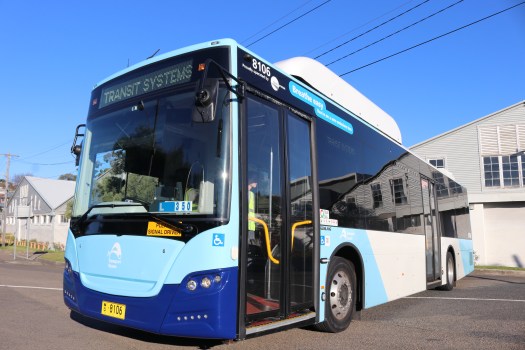
Electric Buses, like this one from Transit Systems, are soon to become more common across Sydney – Transport NSW Blog Collection
“Making the switch to an entirely electric bus fleet will deliver huge benefits to the community in terms of reducing air and noise pollution, as well as our incredible drivers,” Mr Constance said.
“As part of this process, we will challenge the industry to begin an ambitious transformation of our bus fleet from particulate emitting diesel to zero-emission buses.
“The experience of other leading European cities demonstrates that a rapid transition to zero-emission buses is possible and I have asked Transport for NSW to work with operators and bus suppliers to develop a plan to transition our fleet as part of the tender process.
“Zero-emission buses are becoming the standard with the significant environmental, health and operational cost benefits being experienced now in cities like London, Paris and Amsterdam. As a truly global city Sydney deserves the same.”
Currently five electric buses are operating from Transit Systems Leichhardt Depot, with a further ten expected to be delivered to State Transit’s Randwick Depot next year. However deliveries will need to speed up if they want to replace all 8000 Sydney buses anytime soon.
The State Government has announced that 13 of the 14 bus contract regions will be put out to tender next year for a takeover date of 1 July 2021. All regions except for Region 6, which is the Inner West region privatised last year, will be out out to a competitive tender.
Controversially, this will include the three State Transit operated regions. The privatisation of these regions will mean an end to government operated bus services in Sydney after nearly 89 years.
State Transit services across the Eastern Suburbs, Northern Beaches, North Shore and North West are being privatised – Transport NSW Blog Collection






 Transport NSW Blog