Opal Fare Increase from July, but Wollongong Shuttle still free…for now

As of 2 July, Opal fares will increase by 2.2 per cent, in line with the consumer price index (CPI). The Senior/Pensioner Gold Opal won’t change and will remain at $2.50 for all day travel any day of the week.

image

The fare adjustments will also impact daily and weekly caps. The daily cap will increase from $15.40 to $15.80 for adults and from $7.70 to $7.90 for child/concession ticket holders, with the Sunday cap increasing form $2.60 to $2.70 for all passengers. The weekly fare cap will increase from $61.60 to $63.20 for adults and from $30.80 to $31.60 for child/concession ticket holders.

Despite plans to bring the Wollongong Shuttle into the Opal Network as part of this fare increase, a funding agreement was reached between Transport for NSW, Wollongong Council and the University of Wollongong to keep the service free for the next 12 months.

Dodgy Dealings – The non-Inner West bus routes to be privatised

Despite Constance assurances from the State government that only Region 6 Inner West Bus routes are being sold off to Transit Systems and that all other current STA routes will remain in government hands, it now seems that isn’t the case.

IMG_4359

The STA network is very complex and contains some routes which stretch across 2 or more regions. This has meant that some trade offs have had to be made when it comes to delegating routes in the privatisation, with some routes crossing into Region 6 retained by STA and some routes with portions outside of Region 6 being handed over to TSA.

What we are now seeing is the proposed privatisation of routes that either barely scrape the edge of Region 6 and are predominantly based in other regions or in some cases don’t actually operate in Region 6 at all. These decisions come despite constant assurances from Transport Minister Andrew Constance that only Region 6 Inner West bus routes are being sold off.

It is understood by Transport NSW Blog that Transit Systems played a large role in choosing which bus routes they would and wouldn’t operate, in some cases cherry picking more desirable routes, perhaps better suited to STA operation. We also understand that STA was given very limited say in this process, despite the fact that numerous routes in their operating regions are being given away to TSA.

There is some debate over what actually constitutes Region 6 and whether or not the routes have been fairly divided based on the offical drawn boundary maps published by Transport for NSW. For example the eastern boundary of Region 6 on offical maps is from Botany Bay, the Alexandria Canal, Huntley Street, Sydney Park Road, Illawarra Rail line to Central. Theoretically, this puts many routes planned for TSA operation solely in STA operating regions.

There are other instances in which the operation of a route would likely be more efficient in STA hands. If the purpose of privatisation is to make more efficient cheaper services, moving depots further away from termini seems counter intuitive. In one example, the closest STA depot to a routes western terminus (located on the Bordet of Region 6) is 5km away at Ryde, whilst TSA will have a depot 5km away in Leichhardt, this probably doesn’t cause efficiency problems. The bigger issue is when you look at distances from the eastern terminus. The nearest STA depot in Randwick is 3km away, whilst the nearest TSA depot will be in Tempe, some 12km away. In this case it is clear the only consideration has been the routes western terminus being in Region 6 as the route would likely have been much more efficient in STA hands.

The following routes either with only portions inside or entirely outside Region 6 that will be handed over to Transit Systems are;

305, 308, 348, 389, 418, 440, 530, M10, M20, M30, M41 and M50.

With some of these routes, their placement in Region 6 is understandable. Most of these routes are long cross regionals with both large stretches in and out of region 6, making it difficult to classify a route as more Region 6 or more other STA region. It is incorrect however to characterise the privatisation of STA services as limited to the Inner West region 6, as many of these routes operate in Regions 7 and 9.

In particular, I have taken issue with a few routes that I believe would be better off served by STA rather than Transit Systems. The reasons for this are listed next to the route;

  • 305 Railway Square to Stamford Plaza Mascot; Route 305 operates predominantly within STA Region 9 with arguably no part in Region 6. Its operation would be more efficient from Region 9 depots.
  • 308 City Australia Square to Marrickville Metro; Route 308 is arguably a Region 9 route, being mostly located just within the western edge of Region 9. Operation could potentially be more efficient from Region 9 depots.
  • 389 Bondi Junction to Maritime Museum via Five Way; Route 389 operates predominantly within STA Region 9. Its operation would be more efficient from Region 9 depots.
  • M20 Gore Hill to Botany via Zetland; Route M20 operates predominantly within STA Regions 7 and 9, with arguably no part in Region 6. Its operation would be more efficient from Region 7 and 9 depots.
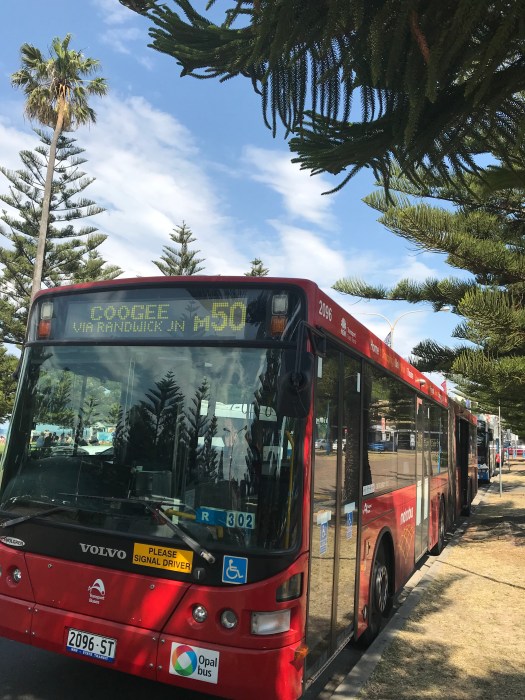
  • M50 Coogee to Drummoyne via Central – Route M50 is interesting, whilst part of the route is technically spilt between Region 6 and STA Region 9, like many other of the Metrobus routes, I believe its operation would still be more efficient from Region 7 and 9 depots. The example above was referring to this route.

In some cases the line between whether a route is better off in Region 6 with TSA or with STA is very fuzzy. In some cases, it is likely that the right decision has been made, but I’m not convinced on the merits of every decision made. Questions need to asked about this process. Are Botany, Mascot and Zetland really the inner west? Should one out of many duplicating routes have been privatised whilst other aren’t? How much power were TSA really given in this decision? Were the STA consulted enough about the changes?


More trains and more services for the T4 and T8 Lines

The number of trains which can run during the morning and afternoon peaks on the T4 Illawarra Line and T8 Airport Line will be increased, following an $880 million investment in technology improvements to modernise the Sydney Trains network.

IMG_0232

Premier Gladys Berejiklian said funding in NSW Budget 2018 will allow for five more trains an hour during the peak on the T4 Illawarra Line from Cronulla, which is an increase of up to 30 per cent in capacity.

The technology improvements will also allow for eight more services an hour on the T8 Airport Line at the International, Domestic, Mascot and Green Square stations, meaning trains at least on average every four minutes instead every six, along with extra services from Revesby.

These upgrades will be delivered in stages with services coming online progressively from the early 2020s.

“At the moment our rail network is complex and reliant on old technologies which limits the number of services we can provide,” Ms Berejiklian said.

“That is why we are making significant investments to improve rail infrastructure and ensure we can continue to meet the growing demand for rail services.

“The T4 Illawarra Line and T8 Airport Line are the first beneficiaries of these signalling upgrades, which will be rolled out across the network – significantly boosting capacity and reliability for all train customers.”

Treasurer Dominic Perrottet said the investment in this technology was an important step in boosting capacity of existing Transport assets.

“We have all had the experience of waiting on an overcrowded platform, so this technology investment will contribute to increasing services and making journeys more comfortable,” Mr Perrottet said.

Minister for Transport and Infrastructure Andrew Constance said the program will start to upgrade parts of the network with state-of-the-art digitalised signalling and control systems used by some of the best railways around the world.

“While we’re building the world class Sydney Metro, it’s important we take action to bring the existing suburban, intercity, and freight services into the 21st Century.

“We are investing in this signalling technology to get more trains on the tracks. Turning old rail into new rail,” Mr Constance said.

In response to recent growth in demand on the T4 Illawarra and T8 Airport lines the program will initially prioritise work to prepare the network to deliver:

  • Up to 30 per cent increase in peak suburban services on the T4 Illawarra Line, as well as more services for South Coast customers.
  • More services for the T8 Airport Line, including a potential 80 per cent increase at the International, Domestic, Mascot and Green Square stations during the morning peak, as well as extra services from Revesby and Campbelltown in south west Sydney.

“For future stages of More Trains, More Services, we’re also investigating how we can add extra services on other lines that we know continue to have high demand, like the T1 Western and Northern Line,” Mr Constance said.

The initial investment of $880 million goes towards developing and starting deployment of digital systems to replace legacy signalling and train control with modern, internationally proven, intelligent systems.

It will also be used for planning the initial stages of the T4 and T8 program, which over the next 10 years will deliver:

  • More services that will reduce wait times, meet demand and provide more seats for long distance customers.
  • Faster travel times for customers through digital train control technology and upgraded rail infrastructure, creating more opportunities for express trains.
  • Improved reliability and reduce customer impacts from incidents.

NSW Budget brings thousands more weekly bus services across the State

More than 2,000 extra weekly bus services will be rolled out across NSW in the next 12 months

7516820976_img_1820

Treasurer Dominic Perrottet and Minister for Transport and Infrastructure Andrew Constance today confirmed the increased services will be part of  the $1.5 billion investment for bus services throughout NSW, including regional and metropolitan bus services, school services and financing of new and replacement buses.

“It is the NSW Government’s strong economic management which is allowing us to provide people across the State with the services they need and deserve,” Mr Perrottet said.

“These extra bus services demonstrate once again that this is a Budget which puts people first and delivers for the community.”

NSW Budget 2018 includes a $15.6 million boost to the Growth Services Program which will provide the extra buses and services where people need them the most.

“As well as delivering thousands of extra services we are also purchasing more than 30 new buses and over 400 replacement buses this year, with around 20 of these new buses to cater for the increased demand in school services across the State,” Mr Constance said.

“Some of the service improvements include expanding route 533 from Sydney Olympic Park to Chatswood via Wentworth Point, which currently operates during peak times only, to operate through Wentworth Point during weekdays and on weekends.

“We’re also delivering more than 1,000 extra weekly services on the Northern Beaches to improve access to the new hospital and meet the growing demand in the Frenchs Forest area.

“In Western Sydney, more than 500 extra weekly services will be introduced in including greater travel options for customers either side of the morning and afternoon peaks.”


The following routes are in line for upgraded services some time in the next 12 months.

More than 500 extra services a week on these routes:

· 614X Crestwood to City via M2

· 662 Box Hill to Riverstone

· 705 Blacktown to Parramatta via Seven Hills

· 783 Penrith to Werrington Station via Jordan Springs

· 804 Bonnyrigg to Parramatta via Fairfield

· 841 Gledswood Hills to Leppington

· 869 Ingleburn to Prestons

· M61 Baulkham Hills to City via M2

· T72 Rouse Hill to Quakers Hill via Alex Avenue

· T74 Stanhope Gardens to Schofields Station

More than 1,000 extra services a week on these routes plus  two new routes and an extended route to support the new Northern Beaches Hospital precinct:

· New route 141 Manly to Austlink via Balgowlah and Northern Beaches Hospital

· 169 Manly and Dee Why to City via Northern Beaches Hospital and Seaforth

· New route 193 Austlink to Warringah Mall via Frenchs Forest and Northern Beaches Hospital

· 136 Manly to Chatswood via Dee Why and Frenchs Forest

· 270, 271 Frenchs Forest District to City

More than 600 extra services a week on the following routes:

· 194 St Ives to City

· 251 Lane Cove West to City via Lane Cove

· 253 Riverview to City via Lane Cove

· 285 Mars Road Lane Cove to City via Lane Cove

· 288 Epping to City via North Ryde

· 292 Lane Cove North to City

· 293 Marsfield to City via Epping Road

· 294 Macquarie University to City via Epping Road

· 313 Coogee to Bondi Junction

· 328 Darling Point to Bondi Junction via Edgecliff

· 343 Kingsford to City via Rosebery

· 386, 387 Vaucluse to Bondi Junction

· 501 West Ryde to Railway Square via Ultimo

· 533 Sydney Olympic Park to Chatswood via Ryde and Wentworth Point

· M54 Parramatta to Macquarie Park via Epping

· X10 Pagewood to Railway Square via Botany Road

· 262, 263 Cameron Park to Charlestown

· 32 Brooks Reach to Dapto

· 686 Katoomba to Echo Point

Parramatta Light Rail Approved

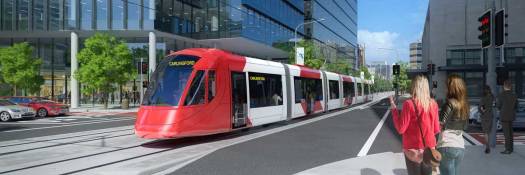
Stage one of the new Parramatta light rail network has today received full planning approval meaning construction will start within months.
PLR-CBDWesternSydneyUniversity_0.jpg

Premier Gladys Berejiklian joined Minister for Transport and Infrastructure Andrew Constance, Minister for Planning Anthony Roberts and Member for Parramatta Geoff Lee in Parramatta today to confirm the approval of stage one of the project from Westmead to Carlingford via Parramatta CBD and Camellia.


“Parramatta Light Rail will connect major Western Sydney precincts for the first time and make it possible for people to ‘turn up and go’ to employment, cultural, entertainment and sports destinations,” Ms Berejiklian said.

“This is an exciting time for the people of Parramatta and for visitors to this fantastic part of Sydney.

“Parramatta Light Rail will create close to 5000 jobs, connect communities along the route and transform the way that people explore all the attractions that Western Sydney has to offer, with a light rail service every 7.5 minutes in peak periods.

“Major projects such as Parramatta Light Rail are only possible thanks to the strong economic management of the NSW Liberals & Nationals Government.”

Mr Constance said approval of stage 1 means construction on the project is on track to begin by the end of 2018.

“Parramatta Light Rail is part of the NSW Government’s $80 billion infrastructure pipeline, which includes the largest transport infrastructure program in Australia with $43 billion of investment over the next four years,” Mr Constance said.

“Parramatta Light Rail Stage 1 will deliver frequent and reliable public transport not only for the people of Parramatta but for all those who come here to work, study, access essential services or to simply relax and take in a football game.”

Stage 1 of Parramatta Light Rail will link Westmead to Carlingford via Parramatta CBD and Camellia, connecting key destinations including the Westmead Precinct, the new Western Sydney Stadium, the new Powerhouse Museum and three Western Sydney University campuses as well as brand-new communities at Camellia and Telopea.

Mr Roberts said planning approval follows extensive consultation with the community, local businesses and major stakeholders, including Westmead Hospital, the Children’s Hospital at Westmead, Western Sydney University, the City of Parramatta Council, Western Sydney Business Chamber and the Parramatta Chamber of Commerce.

“People across the region have taken the time to share their feedback and we have listened, with a number of significant design changes made in response to further investigation and issues raised by stakeholders and the community,” Mr Roberts said.

Dr Lee said Parramatta Light Rail will help the Greater Parramatta Growth Area become better-connected, more accessible and liveable as the region rapidly grows.

“Greater Parramatta is experiencing unprecedented growth, with more than 72,000 new homes planned for this region over the next 20 years. Parramatta Light Rail is an essential part of our plan for this growth,” Dr Lee said.

The next stage is now to issue contracts for contraction of the line later this year before construction actually begins in 2019. the line is expected to open in 2023. It has been confirmed to Transport NSW blog that Acciona, the builder behind the embattled CBD and South East light rail line will not be biddding for this contract due to legal action currently ongoing between it and the State Government.

The government has initially allocated $1 Billion to the first stage of the light rail network, with final costings to be sealed once contracts are finalised.

This is the first stage of a wider proposed Parramatta light rail network that will also include a line to Sydney Olympic Park via Ermington, Melrose Park and Wentworth Point.

Bus Timetable Changes – June 3

There will be a series of major timetable changes for some operators across Sydney from June 3rd. These changes will affect services operated by Busways, Hillsbus and Transit Systems.

Busways Changes 

  • New route 742 – Riverstone to Rouse Hill Town Centre via Guntawong Rd
    New route introduced, running between Rouse Hill Town Centre and Riverstone
    New bus stops added to new route
  • New route 747 – Marsden Park (Elara Estate) to Rouse Hill Town Centre via Riverstone
    New route introduced, running between Rouse Hill Town Centre, Riverstone and Marsden Park
    New route to and from Elara Estate between 9am-2pm, providing direct services to Rouse Hill Town Centre
    New bus stops added to new route
  • 746 – Riverstone to Rouse Hill Town Centre via Box Hill
    Extra trips added to service growing residential areas in Box Hill
    Route 746 extended to Rouse Hill Town Centre via Mill St, Piccadilly St, Garfield Rd East and Edmund St in Riverstone
    Service will no longer run as a loop service, and now as a two-way service between Riverstone and Rouse Hill Town Centre
    New bus stops added to route
  • 749 – Blacktown to Marsden Park
    Route 749 changed to run via Symonds Rd/Stonecutters Dr, and via Alderton Dr
    Provides alternative services via Richmond Rd between Symonds Rd and Alderton Dr for Route 751
  • 751 – Blacktown to Rouse Hill Town Centre via Marsden Park
    Route 751 extended to Schofields Station and Rouse Hill Town Centre
    This service via Stonecutters Dr to Alderton Dr (through Colebee) will operate as a trial
    Route 749, will continue to run on Richmond Rd between Symonds Rd and Alderton Dr
    New bus stops added to route
  • 774 – Mt Druitt to Penrith via Oxley Park, St Marys & Caddens
    Additional weekly trips, with services running morning and evening
    Route 774 runs via Caddens and Claremont Meadows, providing direct access to Penrith, St Marys and Mt Druitt
    Replaces cancelled Route 778 between Caddens and Claremont Meadows
    New bus stops added to route
  • T75 – Blacktown to Rouse Hill
    Route T75 runs between Blacktown Interchange and Rouse Hill (via Rouse Hill Town Centre)
    New Route 747 will run between Rouse Hill Town Centre, Riverstone Station and Marsden Park replacing Route T75 west of Rouse Hill
    Some former Route T75 trips replaced by new school services in Rouse Hill, Schofields and Riverstone areas
  • 778 – St Marys to Caddens
    Route cancelled
    Route 778 services replaced by Route 774, which will run via Caddens and Claremont Meadows
    Residents in Caddens and Claremont Meadows will have direct access to Penrith and Mt Druitt, provided by new service Route 774
  • S12 – Quakers Hill Shopper Hopper
    Route cancelled due to low patronage
    Alternative travel at Quakers Hill available on Route 752
  • Most Western Sydney timetables
    Minor timetable adjustments

Hillsbus Changes

  • 705, 705, T61 Will no longer operate to West Point.
    You will need to go to Blacktown Interchange to catch these services
    711 Will continue to West Point and will now depart from Stand 3
  • 708 Will no longer go via Hawkesbury Rd, Westmead, Stapleton St Wentworthville or Cumberland Highway
  • 600 This service will be discontinued. Customers can now use routes M60, 621 and 632 for their travel needs.
  • 631 This service will be discontinued and replaced by a school service for students. Customers can now use routes M60, 625 632 and 633 for their travel needs.This service will be discontinued and replaced by a school service for students. Customers can now use routes M60, 625 632 and 633 for their travel needs.
  • 612X Castle Hill services will now only operate from North Sydney
    Kellyville Riley Tway services will continue to operate to and from Milsons Point

Transit Systems 

Timetable changes to the following routes

  • 800 Fairfield to Blacktown
  • 801 Badgerys Creek to Liverpool
  • 802 Parramatta to Liverpool
  • 803 Miller to Liverpool
  • 804 Parramatta to Liverpool
  • 805 Cabramatta to Liverpool
  • 806 Parramatta to Liverpool
  • 807 Cabramatta to Liverpool
  • 808 Fairfield to Liverpool
  • 809 Merrylands to Pemulwuy
  • 810 810X Merrylands to Parramatta
  • 811 811X Pemulwuy to Parramatta
  • 812 Fairfield to Blacktown
  • 813 Fairfield to Prairiewood
  • 814 Fairfield to Smithfield (Chifley St)
  • 815 Mt Pritchard to Cabramatta
  • 816 Greenfield Park to Cabramatta
  • 817 Fairfield to Cabramatta
  • 818 Merrylands to Westmead
  • 819 Liverpool to Orange Grove
  • 820 Merrylands to Guildford
  • 821 Guildford to Smithfield industrial area
  • 822 Merrylands to Guildford
  • 823 Liverpool to Warwick Farm
  • 827 Liverpool to Carnes Hill
  • 829 Parramatta and North Parramatta (Hassle Free Nights) Service
  • 835 Prairiewood to WSU Penrith
  • S10 Heckenberg to Miller Shops
  • T80 Parramatta to Liverpool

Offical Light Rail Stop Names Revealed

In some positive news for the much beleaguered CBD and South East Light Rail project, the Geographical Names Board has officially approved the final stop names for all 19 stops along the route.

Mid last year the NSW government submitted names to the Geographical Names Board, who undertook  community consultation on the Government’s proposed names and received extensive feedback.

The intention of the chosen names is to ensure major destinations including Moore Park, the university, hospitals and the racecourse were recognised, alongside the most major geographical features near the stops.

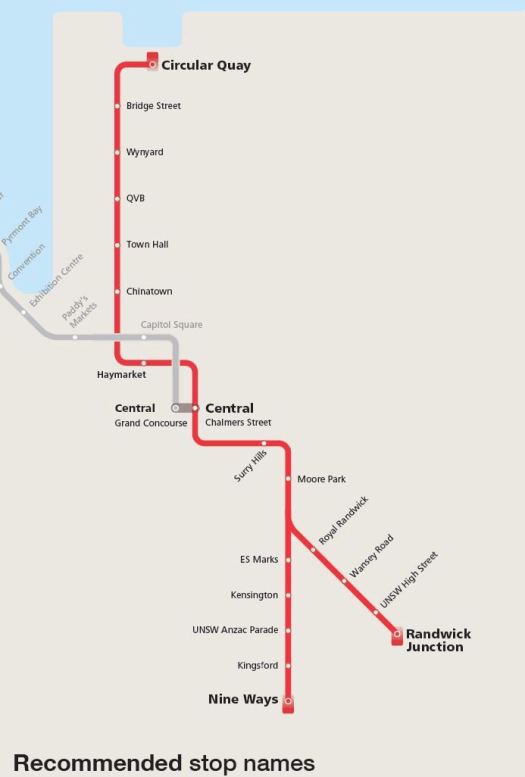
The official light rail stop names are:

  • Circular Quay
  • Bridge Street
  • Wynyard
  • QVB
  • Town Hall
  • Chinatown
  • Haymarket
  • Central Chalmers Street
  • Surry Hills
  • Moore Park
  • Royal Randwick
  • Wansey Road
  • UNSW High Street
  • Randwick
  • ES Marks
  • Kensington
  • UNSW Anzac Parade
  • Kingsford
  • Nine Ways

image

Tallawong Station

It is been announced that the northwest terminus of the new Sydney Metro Northwest line will be Tallawong.

Sydney Metro Tallawong Station.jpg

The station has been known as Cudgegong Road Station during the construction phase. Following community feedback, the station has been named Tallawong, a word with local historical significance that’s derived from the Dharug word ‘dalawang’ for the apple gum tree.

Tallawong Station will serve The Ponds, Rouse Hill and surrounding areas. The station is located between Tallawong and Cudgegong roads. It will be serviced by a new metro train every four minutes in the peak and will have:

  • 1,000 commuter car parking spaces;
  • Four bus bays;
  • 15 kiss-and-ride spaces; and
  • Parking and storage for 55 bicycles

Real Time Train Loadings

From today a number of real time apps such as AnyTrip, NextThere, TripView and others  have been showing real time train loadings for selected services.

This allows customers to see how crowded each indivual carriage on a service is and how that is likely to affect loadings at other stops based on historical data. This will help to allow customers to choose a carriage that is less crowded. You can see the approximate number of seats available or if the carriage is standing room only.

This is currently only available for services run by “Waratah” A set and selected “Millennium” M set trains. The system works by using weight sensors installed in the train to make an estimate of the number of customers in the carriages at any one time.

Farewell Region 6 – What Routes Are Being Privatised Anyway?

fullsizeoutput_788

Transport for NSW and State Transit have this week finally revealed what routes are actually counted as Region 6 and therefore will be handed over to Transit Systems on July 1.

Due to the highly interconnected nature of the STA network, where many routes operated across multiple regions using buses from both regions, this was a complex task. All the routes assigned to either the remaining STA regions or TSA had to be able to be completed with the buses and staff already in that region. This has meant that some cross regional routes, reaching into areas outside of R6 will also be sold off, whilst other routes with large stretches inside R6 will be kept in STA hands.

The following list of routes will be operated by Transit Systems Australia (TSA) from July 1 2018

305, 308, 348 & 389.
401, 406, 407, 408, 412, 413, 415, 418, 422, 423, 425, 426, 428, 431, 433, 436, 438, 439, 440, 441, 442, 444, 445, 460, 461, 464, 466, 470, 473, 476, 477, 478, 479, 480, 483, 487, 490, 491, 492 & 493.
502, 504, 508, 526 & 530.
L23, L28, L37, L38 & L39.
X04, X25 & X26.
M10, M20, M30, M41 & M50.

The following routes currently operated by State Transit (STA) Region 6 have been reallocated to other STA regions and will continue to be operated by STA .

301, 303, 309, 343, 352, 355 & 370.
400, 410 & 458.
501, 506, 510 & 525.